TRLC is a domain-specific language developed at BMW for writing (and linking) requirements with meta-data.
The repository contains:
-
The language reference manual for TRLC. Previous versions are also available.
-
A pure Python reference implementation of TRLC.
The implementation is not very fast, but designed to be pedantically correct in following the language definition. The tools also include a powerful static analysis tool to find issues with types and user-defined check rules.
In a .rsl file, a type may be used before the place where it is
declared in the same file. This is allowed for:
- the type of a record component,
- the type of a tuple field, if that type is a record,
- a record type used as a member of a union type.
Example:
package demo

type Requirement {
  position Coordinate
}

tuple Coordinate {
  x Integer
  y Integer
}
This is valid: Requirement uses Coordinate before the line that declares it.
The following are not supported:
- A tuple field that refers to a tuple declared later in the file. This
includes mutually recursive tuples (
AcontainsB,BcontainsA). Declare the inner tuple first. - A record that extends a type declared later in the file. Declare the base type earlier.
- A check that uses a field of a record type declared after the check. Declare the record type first.
Note:
- Tuples remain acyclic (because they are inline objects)
- Type inheritance graph remains acyclic
- Package import graph remains acyclic
The Python implementation can be used for several purposes:
-
It can be used to validate other TRLC implementations.
-
It can be used to validate a body of requirements (e.g. a CI check that all requirements are well formed)
-
The API can be used to write other tools based on TRLC (for example a tool to render the requirements in HTML, a tool to diff requirements or perform an impact analysis, or a tool to perform software traceability, etc.)
- Tutorial (read this as a first introduction)
- Bazel integration (how to use TRLC inside a Bazel build)
- User manual: TRLC linter (the user manual for the TRLC static analysis and linter)
- Release Notes (read this to find out what’s new)
- License
- Language Reference Manual (for language lawyers)
- Python API Documentation (API reference for end-users)
- AST Hierarchy (overview over all classes in the AST)

- Set up development environment
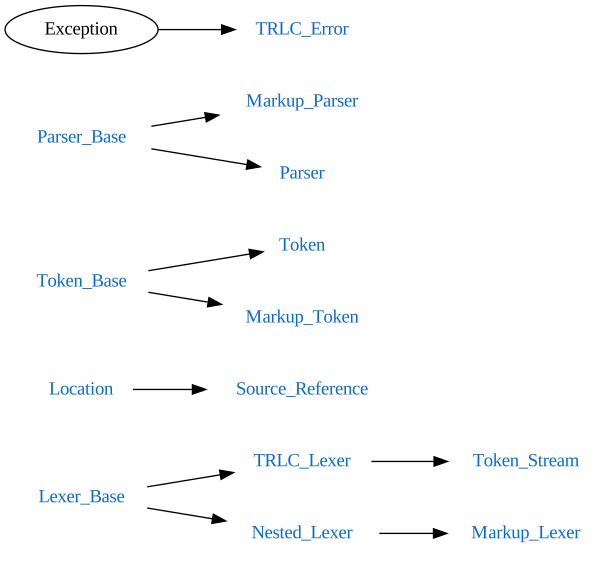
- Lexer/Parser Hierarchy (overview over all classes related to the lexing and parsing of TRLC)
- Tool Architecture Overview
- TRLC Static Checker Slides (Kinda incomplete, designed to go along with a code walkthrough)
- Requirements Coverage Report
- Code Coverage Report
- TRLC_RST: Convert TRLC Requirements for Sphinx Build
- Converters: Multiple converters from TRLC to other file formats. The tool suite is maintained by NewTec GmbH.
Special thanks to Florian Schanda for his many valuable contributions to this repository.